향기 과학

후각이 뇌의 변연계와 직접 연결되는 놀라운 이유: 감정과 기억을 즉시 깨우는 신경과학적 메커니즘

MP0719 2025. 7. 1. 11:24

냄새를 맡는 순간 특정 기억이나 감정이 즉시 떠오르는 경험을 해본 적이 있나요? 이른바 '프루스트 현상'으로 불리는 이 놀라운 현상 뒤에는 후각계의 독특한 신경해부학적 구조가 숨어있습니다.

하버드 대학교의 베카테시 무르티(Venkatesh Murthy) 교수는 "후각 신호는 매우 빠르게 변연계에 도달한다"고 설명하며, "냄새와 감정이 하나의 기억으로 저장된다"고 강조합니다4. 이는 후각이 다른 모든 감각과 구별되는 가장 중요한 특징입니다.
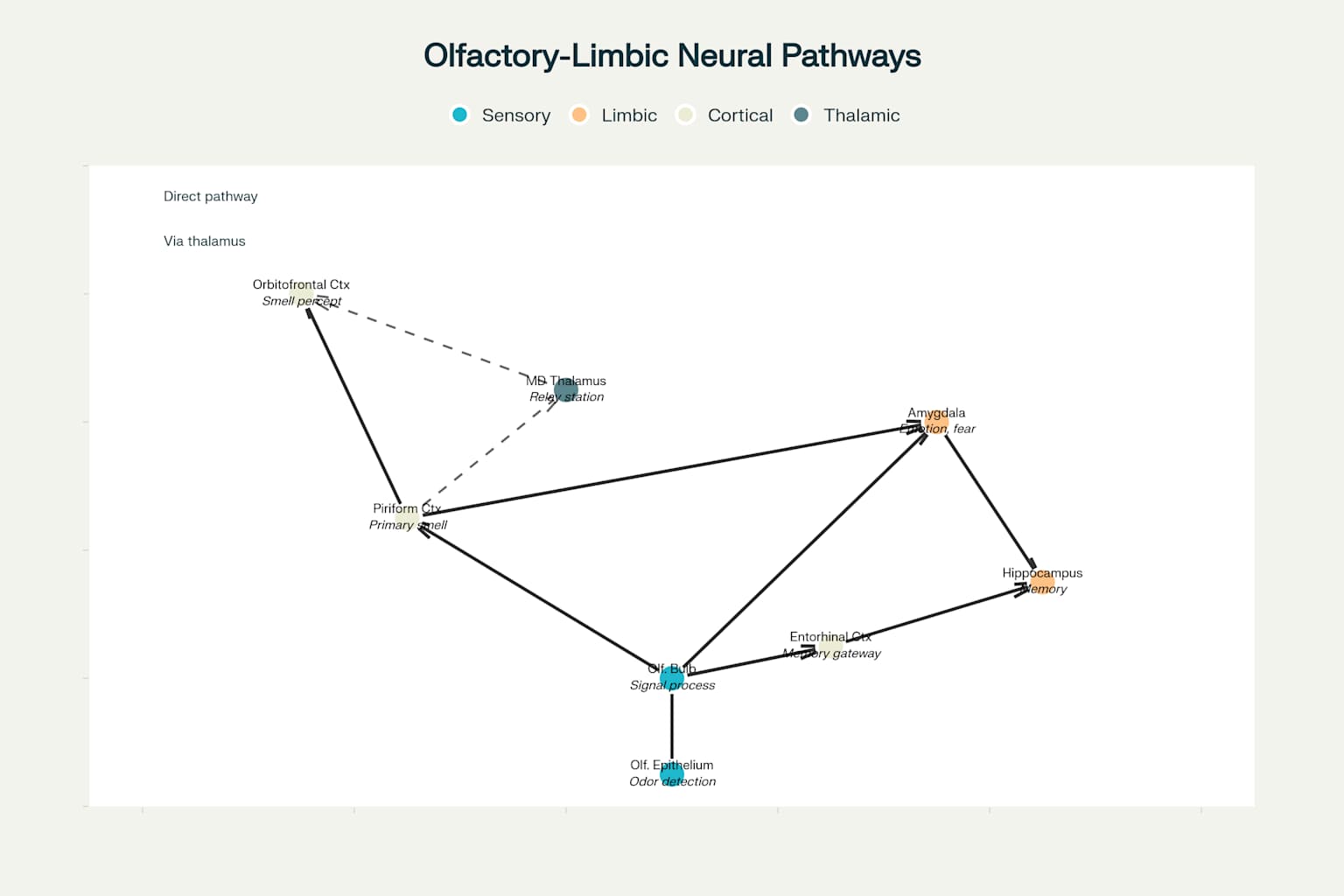
 
후각계에서 변연계로의 직접 신경 경로

후각의 독특한 신경해부학적 구조

시상을 우회하는 유일한 감각

인간의 다섯 감각 중 후각만이 시상(thalamus)이라는 '중계소'를 거치지 않고 직접 뇌의 고차 영역에 연결됩니다56. 시각, 청각, 촉각은 모두 시상을 통해 신호가 처리되어 대뇌피질에 도달하지만, 후각은 후각구(olfactory bulb) → 이상피질(piriform cortex) → 변연계로 직접 연결되는 경로를 갖습니다.

이러한 구조적 차이는 진화적 관점에서 매우 의미가 큽니다. 후각은 포유류 진화 과정에서 상대적으로 보존된 감각 시스템으로, 인간의 일차 후각피질이 다른 감각 시스템과 달리 해마와 더 강한 기능적 연결성을 유지하고 있음이 2021년 연구를 통해 확인되었습니다7.

밀리초 단위의 신경전달 메커니즘

후각 수용체에서 변연계까지의 신호 전달은 놀라울 정도로 빠릅니다. 1996년 네이처지에 발표된 연구에 따르면, 냄새 분자가 감지되면 50ms 이내에 cAMP(cyclic adenosine monophosphate) 농도가 급격히 증가하며, 이는 즉각적인 전기적 신호로 변환됩니다89.

구체적인 분자 메커니즘은 다음과 같습니다:

  1. G단백질 연결 수용체 활성화: 냄새 분자가 후각 수용체에 결합
  2. 아데닐릴 시클라제 활성화: G단백질이 효소를 활성화
  3. cAMP 생성: 50ms 내 10배 이상 농도 증가
  4. 이온 채널 개방: 나트륨과 칼슘 이온 유입
  5. 활동전위 생성: 후각구로 신호 전달

이러한 신속한 신호 전달 시스템은 생존에 위협이 되는 냄새(연기, 부패한 음식 등)를 즉시 감지하고 반응할 수 있게 해줍니다10.
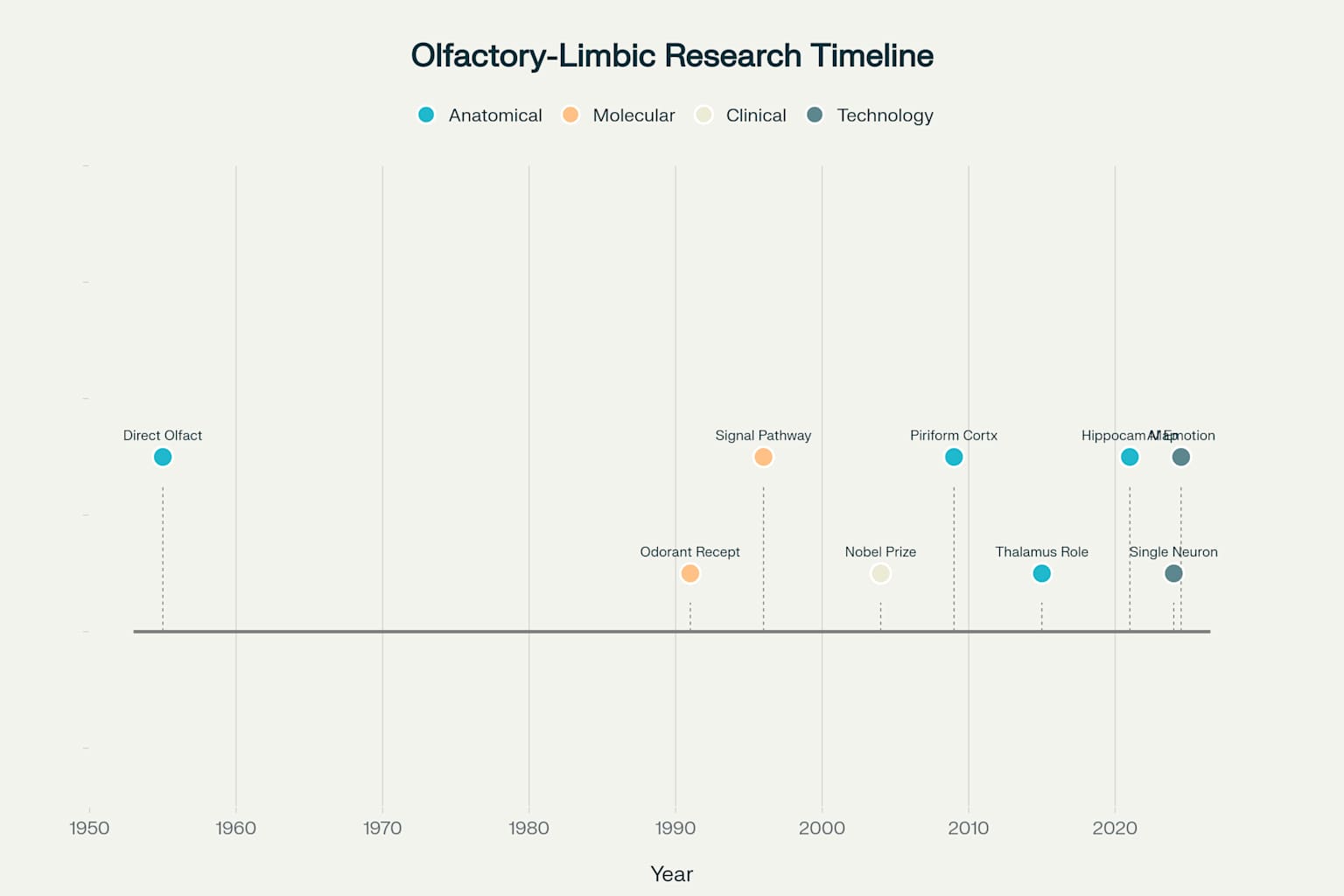
 
후각-변연계 연구의 주요 발견 타임라인

변연계와의 직접 연결 경로

편도체와의 정서적 연결

후각구에서 나온 신호는 편도체(amygdala)의 여러 하위 핵으로 직접 투사됩니다. 2024년 네이처지에 발표된 혁신적인 연구에서는 인간의 개별 뉴런을 직접 기록하여 편도체 뉴런이 **냄새의 주관적 가치(valence)**를 부호화한다는 것을 확인했습니다11.

특히 주목할 점은 편도체의 서로 다른 하위 영역이 구별되는 기능을 갖는다는 것입니다:

  • 외측후피질편도체(posterolateral cortical amygdala): 후각구로부터 가장 많은 투사를 받음
  • 내측편도체(medial amygdala): 사회적 냄새 처리에 특화
  • 전피질편도체(anterior cortical amygdala): 인간에서 가장 강한 후각 입력을 받음12

해마와 기억 형성

해마(hippocampus)는 후각과 독특한 관계를 갖습니다. 2021년 PMC에 발표된 연구에 따르면, 인간의 일차 후각피질은 다른 감각 시스템에 비해 해마와 현저히 강한 기능적 연결성을 보입니다7. 이는 왜 특정 냄새가 생생한 기억을 불러일으키는지를 설명합니다.

해마-후각 연결의 특징:

  • 전방 해마: 후각피질과 더 강한 연결성
  • 해마방회(parahippocampal gyrus): 맥락적 기억 처리
  • 내후각피질(entorhinal cortex): 후각-기억 정보 통합

이상피질의 핵심 역할

이상피질(piriform cortex)은 일차 후각피질의 핵심 구성요소로, 냄새 인식과 변연계 연결의 교량 역할을 합니다513. 최근 연구들은 이상피질이 단순한 냄새 처리를 넘어 다중감각 통합 개념적 부호화에도 관여함을 보여줍니다.

2024년 연구에서는 이상피질 뉴런이 냄새뿐만 아니라 냄새와 관련된 이미지와 단어에도 반응한다는 놀라운 발견이 있었습니다11. 예를 들어, 바나나 냄새에 반응하는 뉴런이 바나나 사진이나 '바나나'라는 단어에도 활성화되는 것입니다.

최신 연구 동향과 논쟁점

시상 경로의 재평가

전통적으로 후각은 시상을 우회한다고 여겨졌지만, 최근 연구들은 **내측배핵시상(mediodorsal thalamus, MDT)**의 역할을 재조명하고 있습니다141516. 2013-2015년 연구들에 따르면, MDT는 후각 주의와 의식적 인식에 중요한 역할을 하며, 특히 후각 주의력이 활성화될 때 시상피질 연결성이 강화됩니다16.

이러한 발견은 후각 처리가 이전에 생각했던 것보다 더 복잡하며, 직접 경로와 시상 경로가 병렬적으로 작동할 가능성을 시사합니다17.

인간과 동물 모델의 차이점

후각-변연계 연결에서 종간 차이도 중요한 연구 주제입니다. 인간의 편도체는 설치류와 다른 패턴을 보이는데, 특히 전피질편도체가 가장 강한 후각 입력을 받는 반면, 설치류에서는 외측후피질편도체가 주요 입력부입니다12.

또한 인간은 설치류가 갖는 부후각계(accessory olfactory system)가 없어, 페로몬 처리 방식에서 근본적인 차이를 보입니다. 이는 인간의 후각-감정 연결이 더 복잡하고 학습에 의존적일 가능성을 시사합니다.

임상적 응용과 치료 가능성

신경퇴행성 질환의 조기 진단

후각 기능 저하는 알츠하이머병과 파킨슨병의 가장 초기 징후 중 하나입니다. 2024년 연구에 따르면 이러한 질환 환자의 95%가 다른 증상보다 10-15년 앞서 후각 장애를 경험합니다12.

최근 개발된 AROMHA 뇌건강 테스트는 집에서 자가 시행할 수 있는 디지털 후각 평가 도구로, 인지기능 저하 위험을 조기에 감지할 수 있습니다18. 이러한 도구들은 비침습적이고 비용 효과적인 선별 검사로 주목받고 있습니다.

후각 훈련과 뇌가소성

2014년부터 시작된 후각 훈련 연구들은 놀라운 결과를 보여주고 있습니다. 체계적인 후각 훈련은 단순히 냄새 감각을 회복시키는 것을 넘어 뇌 구조 자체를 변화시킵니다3.

주요 발견사항:

  • 피질 두께 증가: 우측 하전두회, 방추상회, 내후각피질에서 관찰
  • 기능적 연결성 개선: 이상피질의 비정상적 연결 패턴 정상화
  • 인지기능 향상: 기억력, 주의력, 처리속도 개선19

6주간의 집중적인 후각 훈련만으로도 건강한 성인에서 후각 기능과 뇌 구조 개선이 확인되었습니다.

스트레스와 정신건강

2024년 발표된 연구는 복합 냄새 자극이 급성 및 만성 스트레스의 해로운 효과를 상쇄할 수 있음을 보여줍니다20. 바닐린, 리모넨, 그린 오더(green odor)의 조합은:

  • 급성 스트레스 후 불안 행동 감소
  • 인지 및 공간 기억 결함 예방
  • 만성 스트레스로 인한 우울 증상 완화
  • 전전두피질의 염증성 사이토카인 감소

이는 후각 자극이 변연계의 염증 신호를 조절하여 스트레스 반응을 완화할 수 있음을 시사합니다.

실용적 응용 방법과 도구

일상생활에서의 후각 활용

1. 후각 훈련 프로토콜

  • 기본 4가지 냄새: 장미(꽃향), 레몬(과일향), 정향(매운향), 유칼립투스(상쾌한향)
  • 훈련 방법: 각 냄새를 15초씩 하루 2회, 최소 12주간 지속
  • 진행 기록: 냄새 강도와 식별 능력 변화 추적

2. 스트레스 관리를 위한 아로마 요법

  • 라벤더: 불안 완화와 수면 개선
  • 로즈마리: 집중력과 기억력 향상
  • 시트러스: 기분 전환과 에너지 증진
  • 복합 조합: 개별 향보다 더 강력한 효과

3. 인지기능 향상 전략

  • 학습 시 특정 향 사용: 정보 부호화와 회상 연결
  • 환경적 맥락 활용: 시험 시 동일한 향 사용으로 기억 촉진
  • 후각 다이어리: 냄새와 연관된 기억, 감정 기록

추천 도구와 프레임워크

1. 평가 도구

  • Sniffin' Sticks 테스트: 냄새 역치, 식별, 구별 능력 평가
  • UPSIT (University of Pennsylvania Smell Identification Test): 표준화된 후각 식별 검사
  • AROMHA 디지털 테스트: 자가 진단용 온라인 도구

2. 훈련 장비

  • 에센셜 오일 세트: 고품질 순수 오일 사용
  • 냄새 펜: 휴대용 후각 훈련 도구
  • 아로마 디퓨저: 일정한 농도 유지용

3. 모니터링 앱

  • 후각 훈련 일지: 진행 상황 추적
  • 기분 추적기: 후각 자극과 감정 변화 연관성 분석

미래 연구 방향과 전망

AI와 개인맞춤형 후각 치료

2024-2025년 새롭게 등장하는 연구 분야는 AI 기반 후각-감정 예측 모델입니다. 정 (Jung) 성격 이론에 기반한 맞춤형 향수 추천 알고리즘이나, 개인의 유전적 배경과 후각 선호도를 연결하는 연구들이 진행되고 있습니다.

가상현실과 후각 인터페이스

메타버스와 VR 기술의 발전과 함께 후각 인터페이스 개발이 가속화되고 있습니다21. 이는 단순한 엔터테인먼트를 넘어 치료용 VR, 교육용 시뮬레이션, 원격 의료에서 혁신적 변화를 가져올 것으로 예상됩니다.

정밀의학과 후각 바이오마커

개별 뉴런 수준의 후각 연구가 가능해지면서, 개인별 후각 프로파일을 활용한 정밀의학이 현실화되고 있습니다. 특정 냄새에 대한 뇌 반응 패턴을 분석하여 인지기능 저하 위험을 예측하고, 맞춤형 치료법을 제공하는 시대가 다가오고 있습니다.

결론: 후각의 숨겨진 힘

후각이 변연계와 직접 연결되는 독특한 구조는 단순한 해부학적 특징이 아닙니다. 이는 감정 조절, 기억 형성, 스트레스 관리, 인지기능 향상에 직접적인 영향을 미치는 강력한 치료 도구입니다.

최신 연구들은 체계적인 후각 훈련이 뇌 구조를 개선하고, 복합 냄새 자극이 스트레스를 완화하며, 후각 기능 평가가 치매를 조기 진단할 수 있음을 보여줍니다. 특히 개별 뉴런 수준에서 냄새와 이미지, 언어가 통합 처리된다는 2024년 발견은 후각의 역할에 대한 우리의 이해를 근본적으로 바꾸고 있습니다.

앞으로의 실천 방안:

  1. 일상적인 후각 훈련: 4가지 기본 냄새로 12주 프로그램 시작
  2. 스트레스 관리: 복합 아로마 요법 활용
  3. 조기 건강 점검: 후각 기능 정기 평가
  4. 개인화된 접근: 자신만의 후각-감정 연결 패턴 파악

냄새의 힘을 이해하고 활용한다면, 우리는 더 건강하고 행복한 삶을 살 수 있습니다. 후각은 단순히 냄새를 맡는 감각이 아니라, 뇌와 마음을 연결하는 신비로운 다리입니다.


자료 출처

1. PubMed
pubmed.ncbi.nlm.nih.gov/16928347
Olfactory dysfunction as a predictor of neurodegenerative disease
Olfactory dysfunction is present in patients diagnosed with Alzheimer's disease or idiopathic Parkinson's disease and can differentiate each of these disorders from related disorders with similar clinical presentations. The pathologic hallmarks of each disease are present in brain regions involved i …
2. PubMed
pubmed.ncbi.nlm.nih.gov/34266602
Olfaction as an early marker of Parkinson's disease and Alzheimer's ...
Olfactory impairment is a common and early sign of Parkinson's disease (PD) and Alzheimer's disease (AD), the two most prevalent neurodegenerative conditions in the elderly. This phenomenon corresponds to pathologic processes emerging in the olfactory system prior to the onset of typical clinical ma …
 
3. Frontiers in Systems Neuroscience
pmc.ncbi.nlm.nih.gov/articles/PMC86…
Human Primary Olfactory Amygdala Subregions Form Distinct ...
Three subregions of the amygdala receive monosynaptic projections from the olfactory bulb, making them part of the primary olfactory cortex. These primary olfactory areas are located at the anterior-medial aspect of the amygdala and include the ...
4. Harvard Gazette
news.harvard.edu/gazette/story/…
How scent, emotion, and memory are intertwined - Harvard Gazette
A Harvard panel explores the connection between smell, emotion, and memory.
5. JoVE
jove.com/science-educat…
Physiology of Smell and Olfactory Pathway - JoVE
8.4K Views. Humans detect odors with the help of specialized cells located in the upper part of the nasal cavity, called olfactory receptor neurons (ORNs). ORNs possess hair-like structures called cilia, which are receptive to sensations from the inhaled air. When an odorant molecule binds to a specific receptor on the cell of the cilia, it leads to a series of events that ultimately cause the ORN to send electrical signals to the olfactory bulb in the brain through the olfactory nerves. The olfac...
6. 8.3 The Olfactory System - Introduction to Behavioral Neuroscience
openstax.org/books/introduc…
8.3 The Olfactory System - Introduction to Behavioral Neuroscience
The primary sensory organ for the olfactory system is a sheet of tissue found deep within the nasal cavity called the olfactory epithelium (Figure 8.14)...
 
7. Progress in neurobiology
pmc.ncbi.nlm.nih.gov/articles/PMC80…
Human hippocampal connectivity is stronger in olfaction than other ...
During mammalian evolution, primate neocortex expanded, shifting hippocampal functional networks away from primary sensory cortices, towards association cortices. Reflecting this rerouting, whereas rodent resting functional hippocampal networks ...
8. Nature
nature.com/articles/38572…
Mechanism of odorant adaptation in the olfactory receptor cell | Nature
Adaptation to odorants begins at the level of sensory receptor cells1–5, presumably through modulation of their transduction machinery. The olfactory signal transduction involves the activation of the adenylyl cyclase/cyclic AMP second messenger system which leads to the sequential opening of cAMP-gated channels and Ca2+ -activated chloride ion channels4–7. Several reports of results obtained from in vitro preparations describe the possible molecular mechanisms involved in odorant adaptation; namely, ordorant receptor phosphorylation8,9, activation of phosphodiesterase10, and ion channel regulation11–14. However, it is still unknown whether these putative mechanisms work in the intact olfactory receptor cell. Here we investigate the nature of the adaptational mechanism in intact olfactory cells by using a combination of odorant stimulation and caged cAMP photolysis15 which produces current responses that bypass the early stages of signal transduction (involving the receptor, G protein and adenylyl cyclase). Odorant- and cAMP-induced responses showed the same adaptation in a Ca2+ -dependent manner, indicating that adaptation occurs entirely downstream of the cyclase. Moreover, we show that phosphodiesterase activity remains constant during adaptation and that an affinity change of the cAMP-gated channel for ligands accounts well for our results. We conclude that the principal mechanism underlying odorant adaptation is actually a modulation of the cAMP-gated channel by Ca2+ feedback.
9. embopress
embopress.org/doi/pdf/10.100…
[PDF] Rapid activation of alternative second messenger pathways in ...
primary events mediating the transduction of the molecular signal into an electrical response. Several lines of evidence suggest that olfactory transduction may involve cAMP as second messenger. Phosphodiesterase inhibitors and cAMP modulate the summated receptor potential elicited by odorants in the olfactory epithelium (Minor and Sakina, 1973) and cAMP-gated ion channels were observed in excised patches of ciliary plasma membranes (Nakamura and Gold, 1987); furthermore, high levels of...
10. PubMed
pubmed.ncbi.nlm.nih.gov/8727981
Second messenger signaling in olfactory transduction - PubMed
Olfactory receptor neurons respond to odorants with G-protein mediated increases in the concentration of cyclic adenosine 3',5'-monophosphate (cAMP) and/or inositol 1,4,5-trisphospahte (InsP3). These two second messengers directly regulate opening of cAMP- and InsP3-regulated conductances localized …
11. Nature
nature.com/articles/s4158…
Single-neuron representations of odours in the human brain - Nature
Human piriform and mediotemporal neurons encode odours, and signal how we perceive, rate and identify scents.
 
12. Experimental neurology
pmc.ncbi.nlm.nih.gov/articles/PMC80…
Assessment of direct knowledge of the human olfactory system - PMC
Studies suggest there are topographically defined projections from the bulb to the pars externa (Lledo et al., 2005; Scott et al., 1985), but these do not appear to be maintained in the remainder of the AON (Kay et al., 2011; Miyamichi et al., 2011). However, the entire AON does appear to maintain the dorsal-ventral topography of the bulb (Miyamichi et al., 2011). Rodent studies suggest the pars externa is involved in odor localization (Esquivelzeta Rabell et al., 2017; Kikuta et al., 2010),...
 
13. Kenhub
kenhub.com/en/library/ana…
Olfactory pathway and nerve: Anatomy | Kenhub
How do we smell? This article describes the anatomy of olfactory pathway and nerve, from the nasal cavity to the brain. Learn this topic now at Kenhub.
 
14. Frontiers in Neural Circuits
pmc.ncbi.nlm.nih.gov/articles/PMC45…
The olfactory thalamus: unanswered questions about the role of the ...
The mediodorsal thalamic nucleus (MDT) is a higher order thalamic nucleus and its role in cognition is increasingly well established. Interestingly, components of the MDT also have a somewhat unique sensory function as they link primary olfactory ...
 
15. Journal of Neurophysiology
pmc.ncbi.nlm.nih.gov/articles/PMC39…
Thalamic olfaction: characterizing odor processing in the ...
Thalamus is a key crossroad structure involved in various functions relative to visual, auditory, gustatory, and somatosensory senses. Because of the specific organization of the olfactory pathway (i.e., no direct thalamic relay between sensory ...
16. Journal of Neuroscience
jneurosci.org/content/28/20/…
Attention to Odor Modulates Thalamocortical Connectivity in the ...
It is widely assumed that the thalamus is functionally irrelevant for the sense of smell. Although animal studies suggest that the mediodorsal (MD) thalamus links primary olfactory (piriform) cortex to olfactory neocortical projection sites in orbitofrontal cortex (OFC), this transthalamic route is regarded to be inconsequential, particularly compared with a direct monosynaptic pathway linking piriform cortex and OFC. In this study, we combined functional magnetic resonance imaging with novel effective connectivity techniques to measure attention-dependent network coherence within direct (nonthalamic) and indirect (transthalamic) olfactory pathways. Human subjects were presented with (or without) an odor and with (or without) a tone, while selectively attending to either modality. Attention to odor significantly modulated neural coupling within the indirect pathway, strengthening MD thalamus–OFC connectivity. Critically, these effects were modality specific (odor > tone attention), directionally sensitive (forward > backward connections), and selective to route (indirect > direct pathway). Our findings support the idea that the human transthalamic pathway is an active modulatory target of olfactory attention. The results imply that olfaction, like all other sensory modalities, requires a thalamic relay, if only to consciously analyze a smell.
 
17. Frontiers in Psychology
pmc.ncbi.nlm.nih.gov/articles/PMC38…
The olfactory system as the gateway to the neural correlates of ...
How consciousness is generated by the nervous system remains one of the greatest mysteries in science. Investigators from diverse fields have begun to unravel this puzzle by contrasting conscious and unconscious processes. In this way, it has been ...
18. Nature
nature.com/articles/s4159…
The AROMHA brain health test is a remote olfactory assessment to ...
Cost-effective, noninvasive screening methods for preclinical Alzheimer’s disease (AD) and other neurocognitive disorders remain an unmet need. The olfactory neural circuits develop AD pathological changes prior to symptom onset. To probe these vulnerable circuits, we developed the digital remote AROMHA Brain Health Test (ABHT), an at-home odor identification, discrimination, memory, and intensity assessment. The ABHT was self-administered among cognitively normal (CN) English and Spanish speakers (n = 127), participants with subjective cognitive complaints (SCC; n = 34), and mild cognitive impairment (MCI; n = 19). Self-administered tests took place remotely at home under unobserved (among interested CN participants) and observed modalities (CN, SCC, and MCI), as well as in-person with a research assistant present (CN, SCC, and MCI). Olfactory performance was similar across observed and unobserved remote self-administration and between English and Spanish speakers. Odor memory, identification, and discrimination scores decreased with age, and olfactory identification and discrimination were lower in the MCI group compared to CN and SCC groups, independent of age, sex, and education. The ABHT revealed age-related olfactory decline, and discriminated CN older adults from those with cognitive impairment. Replication of our results in other populations would support the use of the ABHT to identify and monitor individuals at risk for developing dementia.
 
19. Neural Plasticity
pmc.ncbi.nlm.nih.gov/articles/PMC42…
Recovery of Olfactory Function Induces Neuroplasticity Effects in ...
The plasticity of brain function, especially reorganization after stroke or sensory loss, has been investigated extensively. Based upon its special characteristics, the olfactory system allows the investigation of functional networks in patients ...
20. Neuroscience News
neurosciencenews.com/olfaction-imag…
How Brain Cells Identify Smells and Related Images
A recent study reveals that specific brain cells respond not only to smells but also to images and written words related to those scents, providing deeper insight into human odor perception.
 
21. The Journal of Physiological Sciences : JPS
pmc.ncbi.nlm.nih.gov/articles/PMC10…
The olfactory bulb coordinates the ventral hippocampus–medial ...
Neural oscillations synchronize the activity of brain regions during cognitive functions, such as spatial working memory. Olfactory bulb (OB) oscillations are ubiquitous rhythms that can modulate neocortical and limbic regions. However, the ...

리뷰 완료
Fragranzi
fragranzi.co.nz/the-fragranzi-…
Unveiling the Science of the Olfactory System: Why Perfume ...
Imagine walking into a room, catching a whiff of a familiar scent, and suddenly being transported back in time to a cherished memory. The power of perfume to evoke memories is undeniable and fascinating. But have you ever wondered what lies behind this intriguing phenomenon? The olfactory system,
Wikimedia Foundation, Inc.
en.wikipedia.org/wiki/Olfactory…
Olfactory bulb - Wikipedia
The olfactory bulb (Latin: *bulbus olfactorius*) is a neural structure of the vertebrate forebrain involved in olfaction, the sense of smell. It sends olfactory information to be further processed in the amygdala, the orbitofrontal cortex (OFC) and the hippocampus where it plays a role in emotion, memory and learning. The bulb is divided into two distinct structures: the main olfactory bulb and the accessory olfactory bulb. The main olfactory bulb connects to the amygdala via the piriform...
Physiopedia
physio-pedia.com/Olfactory_Cort…
Olfactory Cortex - Physiopedia
Original Editor - Lucinda Hampton
edu
uomustansiriyah.edu.iq/media/lectures…
[PDF] Neuroanatomy 10: Limbic System I- Limbic lobe:
the olfactory bulb. II- Subcortical components: The subcortical component includes the amygdala, olfactory bulb, septal nuclei, hypothalamus and the anterior and dorsomedial nuclei of the thalamus. The subcortical region works in conjunction with the limbic lobe. Amygdala The almond-shaped amygdala (amygdaloid body) is located anterosuperior to the temporal (inferior) horn of the lateral ventricle, deep to the uncus. The apex of the tail of the caudate nucleus fuses with the amygdala in the...
 
Neuroscience
pmc.ncbi.nlm.nih.gov/articles/PMC26…
Amygdala projections to central amygdaloid nucleus subdivisions ...
In rats and primates, the central nucleus of the amygdala (CeN) is most known for its role in responses to fear stimuli. Recent evidence also shows that the CeN is required for directing attention and behaviors when the salience of competing stimuli ...
 
Frontiers in Behavioral Neuroscience
pmc.ncbi.nlm.nih.gov/articles/PMC43…
Olfactory memory networks: from emotional learning to social ...
Torquet et al. (2014) designed a new paradigm to study conditioned olfactory preference (odor-sugar) in rats and investigate resulting changes in the hedonic valence of the odors. They showed that discriminative appetitive conditioning induces not only a preference for the reinforced odor, but also a stable devaluation of the non-reinforced stimulus. Aimé et al. (2014) investigated the modulation of olfactory sensitivity and glucose-sensing by the feeding state in obese Zucker rats using a...
 
Frontiers
frontiersin.org/journals/neuro…
Afferent and Efferent Connections of the Cortex-Amygdala Transition ...
The transitional zone between the ventral part of the piriform cortex and the anterior cortical nucleus of the amygdala, named the cortex-amygdala transition...
soci.org
soci.org/chemistry-and-…
SCI - C&I Issue 2 2024 - More sense from smell
Smell is the only one of our senses with a direct connection to the brain, explaining why a particular smell has the power to evoke a memory or emotion. But could improving our sense of smell also improve memory and cognition? Maria Burke reports
Elife
elifesciences.org/reviewed-prepr…
Olfactory cortical outputs recruit and shape distinct brain-wide ... - eLife
The olfactory system plays a crucial role in driving behavioral responses that are essential for daily functions. This system facilitates social behaviors by integrating olfactory stimuli with other sensory stimuli and prior experiences 1,2. Olfactory systems can discriminate among hundreds to thousands of different odorants given the diversity of odorant receptors that specifically bind to the corresponding odorant molecules 3,4. While olfaction may be more critical for lower-level mammalian...
PubMed
pubmed.ncbi.nlm.nih.gov/16325349
Entorhinal cortex stimulation modulates amygdala and piriform ...
The rodent olfactory bulb sends direct projections to the piriform cortex and to two structures intimately implicated in memory processes, the entorhinal cortex and the amygdala. The piriform cortex has monosynaptic projections with the amygdala and the piriform cortex and is therefore in a position …
Uhnresearch
uhnresearch.ca/news/how-smell…
How Smells Can Transmit Stress - UHN Research
University Health Network (UHN) is a research hospital affiliated with the University of Toronto and a member of the Toronto Academic Health Science Network. The scope of research and complexity of cases at UHN have made it a national and international source for discovery, education and patient care.
 
Seminars in cell & developmental biology
pmc.ncbi.nlm.nih.gov/articles/PMC85…
Olfactory modulation of the medial prefrontal cortex circuitry
Olfactory dysfunction is manifested in a wide range of neurological and psychiatric diseases, and often emerges prior to the onset of more classical symptoms and signs. From a behavioral perspective, olfactory deficits typically arise in conjunction ...
alliantievoeding.nl
alliantievoeding.nl/en/topical/the…
The Smell and taste centre®: a decade of advancing research
27 FEBRUARY 2025 Yanyang completed her master’s degree in China focusing on chemosensory science. Recognizing the limited global research on this topic, she moved to the Netherlands to pursue a doctorate and contribute to this important field of study. Her research investigates the complexities of smell loss, a condition that has gained increasing attention due to the COVID-19 pandemic. “Smell loss can have a much greater impact than people think. It not only affects the ability to experience...
Frontiers
frontiersin.org/journals/psych…
Olfactory consciousness and gamma oscillation couplings across ...
The orbitofrontal cortex receives multi-modality sensory inputs, including olfactory input, and is thought to be involved in conscious perception of the olfa...
ufhealth.org
ufhealth.org/news/2025/stud…
Study: What makes a smell bad? - UF Health
GAINESVILLE, Fla. — You wouldn’t microwave fish around your worst enemy — the smell lingers both in kitchen and memory. It is one few of us like, let alone…
Nature
nature.com/articles/s4159…
Identifying the human olfactory and chemosignaling neural networks ...
This study aims to characterize and compare the functional neural networks associated with different olfactory stimuli, including air, non-social odours, and human body odours. We introduce a novel processing pipeline based on event-related functional magnetic resonance imaging (fMRI) and graph theory for network identification. To ensure the stability and small worldness of the characterized networks, we conduct statistical validations, network modularity assessments, and robustness measurement against local attacks. The key hypothesis is that human body odours (so-called social odours) and non-social odours engage distinct neural networks, particularly in regions responsible for social processing. We found that the posterior medial orbitofrontal cortex (pmOFC) and fusiform face area (FFA) demonstrate stronger centrality in the body odour network than the non-social odour and air networks. This observation supports the idea that social and olfactory information are integrated in the body odour network. Additionally, the anterior insula (INSa), posterior piriform cortex (PPC), and amygdala (AMY) exhibit high influence in air and odour networks by achieving higher centrality indices and playing a major role in improving the global efficiency. These findings offer impactful insight into how air, non-social, and social odours recruit distinct neural circuits, reinforcing the role of olfaction in human social behavior.
 
National Institute on Aging
nia.nih.gov/news/sense-sme…
Sense of smell linked to speed of brain loss and cognitive decline
Study finds associations between ability to identify smells with rates of brain volume loss and cognitive decline and dementia.
OUP Academic
academic.oup.com/braincomms/art…
Olfactory stimulation with multiple odorants prevents stress-induced ...
Bandiera and Natale et al. reported that olfactory stimulation using multiple odorants halts the detrimental effects of both acute and chronic stress on mo
PubMed
pubmed.ncbi.nlm.nih.gov/30630079
Smell training improves olfactory function and alters brain structure
Training and repeated exposure to odorants leads to enhanced olfactory sensitivity. So far, the efficacy of intensive olfactory training on olfactory function in a healthy population and its underlying neurobiological basis remain poorly known. This study investigated the effects of a 6-week intensi …
bbc.co
bbc.co.uk/science/humanb…
Nervous system - Smell - BBC
sciencedirect
sciencedirect.com/science/articl…
Human hippocampal connectivity is stronger in olfaction than other ...
mdpi
mdpi.com/2076-3425/15/4…
The Bulb, the Brain and the Being: New Insights into Olfactory ...
bslonline
bslonline.org/journal/view.h…
The Impact of Olfactory System Stimuli on Stress and Brain Activity
더 보기