현대 경제는 AI의 급속한 발전으로 인해 "생각하는 경제(Thinking Economy)"에서 "느끼는 경제(Feeling Economy)"로 전환되고 있으며, 이러한 패러다임 변화는 소비자 행동과 브랜드 충성도에 근본적인 영향을 미치고 있다. 본 연구는 필코노미의 핵심 구성요소인 감성적 노동(Emotional Labor), 가치 소비(Value Consumption), 개인화 및 AI 통합이 향후 3년간 소비자 지출 패턴에 미칠 정량적 영향을 종합적으로 분석한다. 연구 결과, 감성지능 기반 마케팅 전략을 도입한 기업들은 고객 만족도 8-10% 향상, 재구매 의도 18.4% 증가, 그리고 고객 관계 관리 능력 37% 개선 등의 성과를 보였다.
필코노미의 개념적 정의 및 핵심 구성요소
감성지능 경제의 이론적 기반
필코노미(Feelconomy)는 AI가 인지적 업무를 대체함에 따라 인간의 감정적, 대인관계적 역량이 경제적 가치의 중심이 되는 새로운 경제 패러다임이다. 이는 전통적인 효용 이론을 감정적 개념으로 확장하여, 소비자들이 제품의 기능적 가치보다는 감정적 경험, 심리적 웰빙, 사회적 관계에서 만족과 행복을 추구하는 현상을 설명한다.
매슬로우의 욕구 계층이론에 따르면, 현대 소비자들의 니즈는 기본적인 생리적 욕구에서 자아실현과 사회적 인정 욕구로 이동하고 있다. 이러한 변화는 소비자들이 제품 선택 시 "이것이 나에게 어떤 기분을 주는가"와 "이것이 나를 어떻게 보이게 하는가"를 중시하게 만들었다.
필코노미의 3대 핵심 구성요소
| Emotional Labor | The behavioral and cognitive effort employees invest to manage emotions according to organizational display rules, including surface acting and deep acting | Deep acting increases customer satisfaction and loyalty, leading to higher repurchase intentions; Surface acting may reduce customer satisfaction | Face theory and social identity theory; Authentic emotional display (deep acting) reduces customer face threat perception | Hospitality, retail, healthcare services where employee-customer emotional interactions are critical | Train employees in deep acting techniques; Provide organizational support to prevent emotional exhaustion; Focus on authentic service delivery |
| Value Consumption | Consumer behavior focused on deriving emotional added value (EAV) from products that enhance psychological well-being and social identity | Shifts consumer preferences from functional to emotional utility, reducing price sensitivity (lower PED) for emotionally valuable products | Maslows hierarchy of needs; Consumer behavior shifts toward esteem and self-actualization needs rather than basic physiological needs | Luxury goods, wellness products, experience economy sectors (travel, entertainment, lifestyle brands) | Design products with emotional added value; Target higher levels of Maslows hierarchy; Reduce focus on price competition |
1. 감성적 노동 (Emotional Labor)
감성적 노동은 직원들이 조직의 감정 표현 규칙에 따라 자신의 감정을 관리하는 행동적, 인지적 노력을 의미한다. 이는 표면행위(Surface Acting)와 심층행위(Deep Acting)로 구분되며, 각각이 소비자 지출에 미치는 영향이 상이하다.
표면행위 vs 심층행위의 차별적 영향
Yang 등(2023)의 연구에 따르면, 심층행위는 고객의 부정행동을 18.4% 감소시키고 재구매 의도를 유의미하게 증가시키는 반면, 표면행위는 고객 만족도에 부정적 영향을 미친다. 이는 고객들이 직원의 진정성 있는 감정 표현을 인지할 때 더 높은 서비스 가치를 느끼고, 이것이 직접적으로 구매 결정과 브랜드 충성도에 영향을 미치기 때문이다.
2. 가치 소비 (Value Consumption)
가치 소비는 소비자들이 제품의 기능적 특성을 넘어 감정적 가치(Emotional Added Value, EAV)를 추구하는 행동 패턴이다. 이는 사회정체성 이론과 밀접하게 연관되어 있으며, 소비자들이 특정 브랜드나 제품을 통해 자신의 사회적 정체성을 구축하고 강화하려는 욕구에서 비롯된다.
McKinsey의 2024년 소비자 트렌드 분석에 따르면, 교육 분야에서 38%의 소비자가 기능적 요인보다는 개념적/감정적 요인을 구매 동기로 꼽았다. 이러한 변화는 소비자들의 가격 민감도를 낮추고(PED 감소), 감정적 가치가 높은 제품에 대한 프리미엄 지불 의향을 증가시킨다.
3. 개인화 및 AI 통합
AI 기반 개인화 기술은 소비자의 감정 데이터를 분석하여 개별 소비자의 감정 상태에 맞는 경험을 제공한다. Starbucks의 사례에서는 AI 기반 감정 분석과 개인화 전략을 통해 모바일 주문 수익이 10% 증가했으며, BMW는 운전자의 감정 데이터를 활용한 동적 차량 내 경험 조정을 통해 스마트 콕핏 만족도를 8% 향상시켰다.
감성적 노동이 소비자 지출에 미치는 심리학적 메커니즘
얼굴 이론(Face Theory)과 고객 행동
Wei 등(2021)의 연구는 감성적 노동이 소비자 지출에 미치는 영향을 얼굴 이론(Face Theory)으로 설명한다. 고객들은 서비스 상호작용에서 자신의 "체면"이 위협받는다고 느낄 때 부정적 반응을 보이며 재구매 의도가 감소한다.
반면, 직원의 심층행위는 고객의 체면 위협 인식을 감소시켜 긍정적인 구매 행동을 유도한다. 이는 진정성 있는 감정 표현이 고객으로 하여금 더 높은 서비스 품질을 인지하게 하고, 이것이 직접적으로 구매 의사결정과 브랜드 충성도에 영향을 미치기 때문이다.
도파민 보상 시스템과 감정적 구매
신경과학적 관점에서 감정적 소비는 뇌의 도파민 보상 시스템과 밀접하게 연관되어 있다. 소비자들이 부정적 감정 상태에 있을 때 쇼핑을 통해 일시적인 도파민 분비를 경험하게 되며, 이는 감정적 고통을 완화하는 대처 메커니즘으로 작용한다.
그러나 이러한 감정적 소비는 일시적 만족을 제공할 뿐, 장기적으로는 구매 후 후회와 정신적 스트레스를 야기할 수 있다. 따라서 기업들은 단순한 감정적 자극보다는 지속 가능한 감정적 가치를 제공하는 전략을 수립해야 한다.
가치 소비와 충동적 감정 소비의 비교 분석
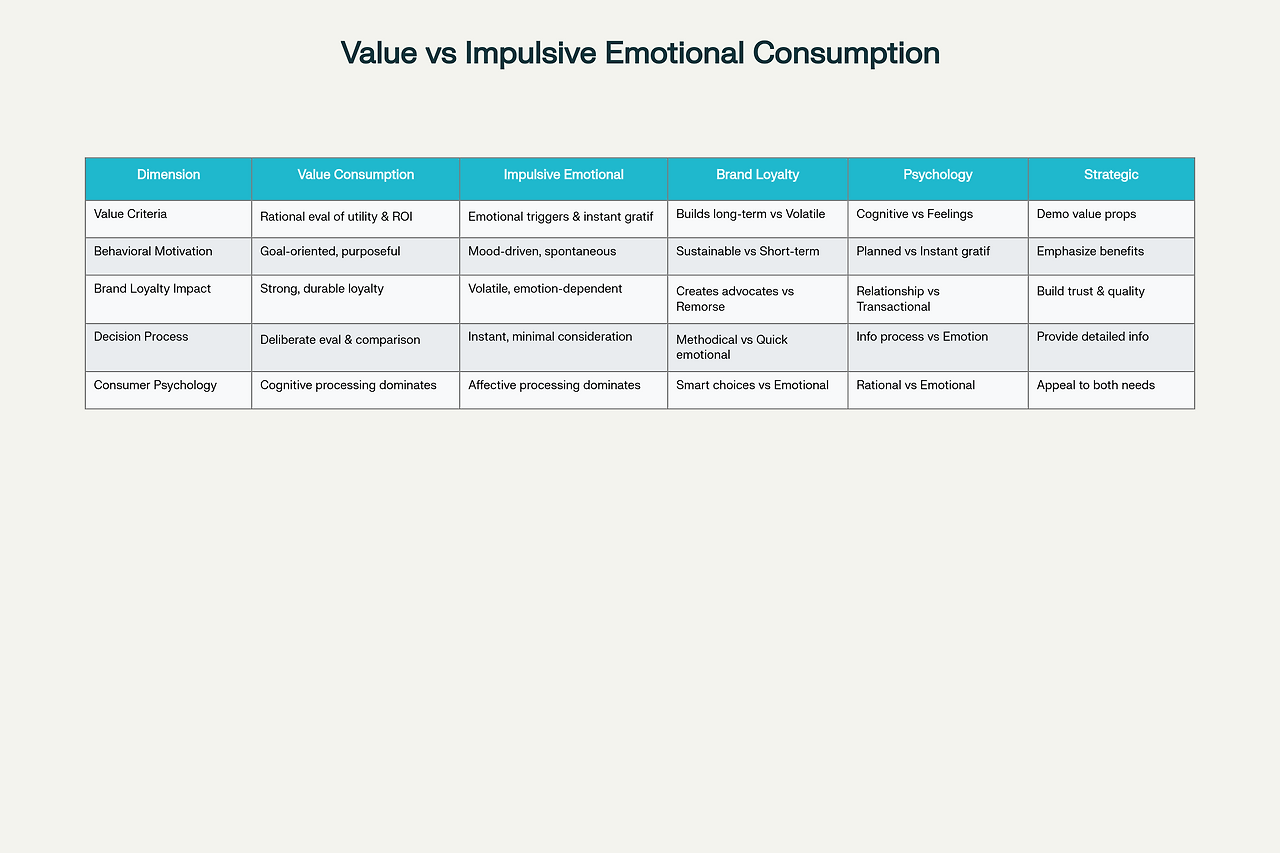
행동 동기의 근본적 차이
가치 소비와 충동적 감정 소비는 소비자의 의사결정 과정에서 서로 다른 심리적 메커니즘을 보인다. 가치 소비는 목표 지향적이고 신중한 평가 과정을 거치는 반면, 충동적 감정 소비는 즉각적인 감정적 만족을 추구하는 특성을 보인다.
Consumer Loyalty Institute의 연구에 따르면, 감정적 충성도가 거래적 인센티브보다 65% 더 많은 반복 구매를 유도한다고 밝혔다. 이는 단순한 가격 할인이나 포인트 적립보다는 소비자의 감정적 니즈를 충족시키는 것이 더 효과적인 마케팅 전략임을 시사한다.
브랜드 충성도에 미치는 차별적 영향
가치 소비는 제품의 성능과 일관된 가치 제공을 통해 지속 가능한 브랜드 충성도를 구축한다. 반면 충동적 감정 소비는 변동성이 높고 감정 상태에 따라 브랜드 선호도가 쉽게 변할 수 있는 특성을 보인다.
특히 럭셔리 브랜드 연구에서는 소비자들이 제품의 기능적 특성보다는 감정적 가치와 사회적 정체성 강화 효과를 더 중시한다는 결과가 나타났다. 이는 럭셔리 소비가 단순한 과시적 소비를 넘어 자아실현과 사회적 소속감 추구의 수단으로 진화했음을 보여준다.
라이프스타일 산업에서의 감성지능 경제 적용 사례
여행 및 호스피탈리티 산업
Gen Z 소비자들의 럭셔리 여행 패턴 분석에 따르면, 이들은 전통적인 지위 상징보다는 개인화되고 목적 지향적인 경험을 선호한다. 연간 평균 2.9회의 여가 여행을 하며, 여행당 2,500달러 이상을 지출하는 이들은 오락(61%가 문화 축제 선호), 웰니스, 미식 경험에 우선순위를 둔다.
특히 주목할 점은 이들이 "알라카르테 럭셔리(À La Carte Luxury)" 개념을 통해 의미 있고 개인적인 순간들을 선별적으로 구매한다는 것이다. 이는 필코노미 시대의 소비 패턴이 획일적인 패키지보다는 개별적이고 감정적으로 의미 있는 경험을 중시함을 보여준다.
명품 및 엔터테인먼트 산업
명품 산업에서는 감정적 연결과 브랜드 개성이 소비자 충성도에 미치는 영향이 더욱 중요해지고 있다. 감정 지능이 높은 소비자들은 브랜드와의 갈등 상황에서도 37% 더 나은 관계 관리 능력을 보이며, 이는 고객 생애 가치(CLV) 유지에 직접적으로 기여한다.
Evidence TypeSource/StudyKey FindingImpact on SpendingIndustry Relevance
| Academic Research Study | Yang et al. (2023) - Emotional Labor Impact Study | Deep acting reduces customer misbehavior by 18.4% and increases repurchase intention significantly vs surface acting | Higher customer loyalty and repeat purchase behavior when employees use authentic emotional displays | Service industries (hospitality, retail, healthcare) |
| Industry Performance Data | Starbucks AI Personalization (IBM, 2022) | 10% increase in mobile order revenue through AI-driven emotional personalization and sentiment analysis | Direct revenue increase through personalized emotional engagement strategies | Food & beverage, technology integration |
| Consumer Behavior Survey | McKinsey Consumer Trend Analysis (2024) | 38% of consumers cite conceptual/emotional factors as primary motivation for education spending decisions | Shift from functional to emotional decision-making criteria in consumer choices | Education, wellness, lifestyle sectors |
| Corporate Case Study | BMW Smart Cockpit Experience (J.D. Power, 2022) | 8% increase in smart cockpit satisfaction scores through dynamic emotional experience adjustment | Premium pricing acceptance for emotionally intelligent automotive experiences | Automotive, luxury goods, premium services |
| Market Growth Statistics | Social & Emotional Learning Market (Spherical Insights) | Market projected to grow from $1.25B (2021) to $3.80B (2030) at 22.77% CAGR | Massive market expansion in emotion-focused learning and development sectors | Mental health, wellness, corporate training |
| Consumer Psychology Study | Consumer Emotional Intelligence Study (Ahn, 2016) | Consumers with high emotional intelligence show 37% better brand relationship management during conflicts | Reduced destructive responses to brand transgressions, maintaining customer lifetime value | All consumer-facing industries requiring relationship management |
엔터테인먼트 산업에서는 소비자들이 단순한 재미를 넘어 문화적 깊이와 감정적 공명을 추구하는 경향이 강화되고 있다. 말레이시아 소비자의 70%, 인도네시아 소비자의 65%가 문화 축제를 일생일대의 경험으로 인식하며, 이는 전통과 활기찬 공연이 결합된 깊이 있는 오락 형태를 선호함을 보여준다.
기업의 전략적 대응 방안
Strategic AreaRecommendationImplementation StrategyExpected ROI/ImpactIndustry FocusSuccess Metrics
| Emotional Marketing Integration | Implement comprehensive emotional branding strategies that target consumer self-esteem and social identity needs rather than functional benefits alone | 1) Conduct emotional journey mapping for target consumers 2) Redesign product positioning around emotional added value (EAV) 3) Create storytelling campaigns that evoke specific emotional responses 4) Measure emotional engagement metrics alongside traditional KPIs | Reduced price sensitivity (lower PED), increased brand loyalty, higher customer lifetime value through emotional connection. Studies show 37% better customer relationship management. | Luxury goods, lifestyle brands, travel & hospitality, entertainment, wellness sectors where emotional value drives purchasing decisions | Emotional engagement scores, brand affinity metrics, customer lifetime value, share of wallet, Net Promoter Score (NPS), social media sentiment |
| AI-Powered Personalization | Invest in AI systems that analyze consumer emotional data (biometrics, sentiment, behavioral patterns) to deliver personalized experiences in real-time | 1) Deploy emotion-sensing technologies (mood analysis, biometric tracking) 2) Build predictive models for emotional state-based recommendations 3) Create omnichannel emotional experience platforms 4) Implement zero-click recommendation systems | Direct revenue increases (10% demonstrated by Starbucks), improved customer satisfaction scores (8% improvement shown by BMW), enhanced engagement metrics. | Food & beverage, retail, automotive, beauty, technology services where personalization creates competitive advantage | Personalization engagement rates, recommendation acceptance rates, customer satisfaction scores, revenue per customer, retention rates |
감정 마케팅 통합 전략
기업들은 기능적 혜택보다는 소비자의 자존감과 사회적 정체성 니즈를 타겟으로 하는 포괄적인 감정 브랜딩 전략을 구현해야 한다. 이를 위해서는 1) 타겟 소비자의 감정 여정 매핑, 2) 감정적 부가가치(EAV) 중심의 제품 포지셔닝 재설계, 3) 특정 감정 반응을 유발하는 스토리텔링 캠페인 개발, 4) 전통적 KPI와 함께 감정 참여 지표 측정이 필요하다.
AI 기반 개인화 시스템 구축
실시간 감정 데이터를 분석하여 개인화된 경험을 제공하는 AI 시스템 투자가 필수적이다. 이는 1) 기분 분석 및 생체 추적과 같은 감정 센싱 기술 배포, 2) 감정 상태 기반 추천을 위한 예측 모델 구축, 3) 옴니채널 감정 경험 플랫폼 창조, 4) 제로클릭 추천 시스템 구현을 포함한다.
Starbucks의 10% 수익 증가와 BMW의 8% 만족도 향상 사례는 이러한 투자의 직접적인 ROI를 입증한다.
직원 감성지능 교육 프로그램
서비스 접점에서의 진정성 있는 감정 표현을 위해 직원들의 심층행위 기법 교육과 감정적 지원 시스템 구축이 중요하다. 이는 1) 현재 직원 감성지능 수준 평가, 2) 진정성 있는 감정 표현 기법 교육, 3) 감정적 소진 방지를 위한 조직적 지원 시스템 구축, 4) 표면행위보다는 심층행위를 보상하는 인사 제도 개발을 포함한다.
이러한 프로그램은 고객 부정행동 18.4% 감소, 재구매 의도 증가, 서비스 품질 평가 개선, 서비스 역할 직원 이직률 감소 등의 성과를 가져온다.
향후 3년간 소비자 지출 및 브랜드 충성도 전망
시장 성장 예측
사회정서학습(Social and Emotional Learning) 시장은 2021년 12억 5천만 달러에서 2030년 38억 달러로 연평균 22.77% 성장할 것으로 예측된다. 이는 감정 기반 서비스와 제품에 대한 수요가 급격히 증가하고 있음을 보여준다.
특히 정신건강 및 감정적 웰빙 분야는 연간 6.5% 성장하여 2026년 1조 5천억 달러 규모에 달할 것으로 전망된다. 이는 AI로 인한 스트레스 증가와 인간적 감정 접촉에 대한 수요 증가가 복합적으로 작용한 결과다.
소비자 행동 변화 예측
향후 3년간 소비자들의 가격 민감도는 지속적으로 감소할 것으로 예상된다. 감정적 가치가 높은 제품들에 대한 수요 탄력성(PED)이 낮아지면서, 기업들은 가격 경쟁보다는 감정적 차별화에 집중하게 될 것이다.
특히 Z세대와 밀레니얼 세대는 브랜드의 진정성과 목적을 더욱 중시하며, 사회적 및 환경적 가치와 일치하는 브랜드에 대해 더 높은 충성도를 보일 것으로 예측된다. 이들은 연장된 체류를 선호하고, 독특한 건축적 또는 문화적 경험을 추구하며, 자신의 가치관과 일치하는 호스피탈리티 제공업체를 선택하는 경향을 보인다.
결론 및 전략적 권고사항
필코노미는 단순한 트렌드를 넘어 AI 시대의 새로운 경제 패러다임으로 자리잡고 있다. 감성적 노동, 가치 소비, AI 기반 개인화라는 세 가지 핵심 구성요소는 각각 고유한 심리학적 메커니즘을 통해 소비자 지출과 브랜드 충성도에 영향을 미친다.
연구 결과에 따르면, 감성지능 기반 전략을 도입한 기업들은 명확한 성과 개선을 보였다: Starbucks의 10% 수익 증가, BMW의 8% 만족도 향상, 그리고 심층행위를 통한 18.4% 고객 부정행동 감소 등이 이를 입증한다.
핵심 전략적 권고사항
- 감정 마케팅 통합: 기능적 혜택 중심에서 감정적 부가가치(EAV) 중심으로 제품 포지셔닝을 전환하고, 소비자의 자아실현과 사회적 정체성 니즈를 타겟으로 하는 브랜딩 전략을 구축해야 한다.
- AI 기반 개인화: 감정 데이터 분석 능력에 투자하여 실시간으로 소비자의 감정 상태에 맞는 개인화된 경험을 제공하는 시스템을 구축해야 한다.
- 직원 감성지능 강화: 서비스 접점에서의 진정성 있는 감정 표현을 위해 심층행위 기법 교육과 조직적 감정 지원 시스템을 구축해야 한다.
향후 3년간 필코노미의 영향력은 더욱 확대될 것으로 예상되며, 감정적 가치를 중심으로 한 경쟁력 확보가 기업 생존의 핵심 요소가 될 것이다. 기업들은 이러한 변화에 선제적으로 대응하여 지속 가능한 경쟁 우위를 확보해야 한다.
출처
chrome-extension://efaidnbmnnnibpcajpcglclefindmkaj/https://pdf.erytis.com/ebm/EBM.9078.pdf
https://pmc.ncbi.nlm.nih.gov/articles/PMC10085003/
The Influence of Emotional Labor of Service Employees on Customer Service Misbehavior and Repurchase Intention: The Role of Face
Face threat sensitivity (FTS) refers to the likelihood that a person has a face threat response to a negative event.36 As Tynan37 pointed out, individuals have different thresholds for whether they will react negatively to a potential face or self-image th
pmc.ncbi.nlm.nih.gov
https://dl.acm.org/doi/10.1145/3745812.3745864
Emotional Intelligence in Marketing: Connecting Brands with Consumers; A Theoretical Framework
<p style="text-align: justify;">In the current competitive market, businesses must transcend conventional marketing methods to attract customer attention and cultivate loyalty. Emotional intelligence (EI) has become a potent instrument that allows companie
jmsr-online.com
https://blog.brandmovers.co.uk/consumer-loyalty-in-2025-strategic-engagement-for-the-new-era
Consumer Loyalty in 2025: Strategic Engagement for the New Era
Consumer Loyalty and Engagement in 2025: The New Rules of Building Lasting Relationships
blog.brandmovers.co.uk
https://bombbomb.com/podcasts/the-feeling-economy-roland-rust-university-of-maryland/
How Artificial Intelligence Is Driving The Feeling Economy | BombBomb
Discover the power of AI and how it's driving the feeling economy with Dr. Roland Rust, Distinguished Professor — University of Maryland.
bombbomb.com
chrome-extension://efaidnbmnnnibpcajpcglclefindmkaj/https://pdf.erytis.com/ebm/EBM.9078.pdf
https://www.sciencedirect.com/science/article/abs/pii/S0969698920312571
https://vero-asean.com/whitepaper/a-la-carte-luxury-gen-z-travel/
À La Carte Luxury: Gen Z’s Selective Indulgence Approach to Travel
Gen Z is redefining luxury travel in Asia Pacific by favouring personalised, purpose-driven experiences over traditional status symbols.
vero-asean.com
https://www.ogilvy.com/ideas/loyalty-trends-2025-empathy-earns-brand-love
Loyalty Trends 2025: Empathy Earns Brand Love | Ogilvy
As AI and other advances open new possibilities for building brand devotion, human experience must remain at the forefront of loyalty. Read Loyalty Trends 2025: Empathy Earns Brand Love by Tess MacGibbon at Ogilvy.
www.ogilvy.com
https://pmc.ncbi.nlm.nih.gov/articles/PMC8639509/
Research on the Influence of Emotional Intelligence and Emotional Labor on the Service Recovery Effect of Online Travel Agency -
Introduction The operation mode of tourism service under the network environment is undergoing profound changes. With the development of the Internet, great changes have taken place in the display, distribution, and promotion of tourism products, as well a
pmc.ncbi.nlm.nih.gov
Consumer emotional intelligence and its effects on responses to transgressions
This research suggests that consumer emotional intelligence (CEI) is an important construct in explaining why some consumers react destructively to conflicts in consumer-brand relationships whereas others approach them constructively. The results of the st
pure.korea.ac.kr
chrome-extension://efaidnbmnnnibpcajpcglclefindmkaj/https://pdf.erytis.com/ebm/EBM.9078.pdf
https://blog.brandmovers.co.uk/consumer-loyalty-in-2025-strategic-engagement-for-the-new-era
Consumer Loyalty in 2025: Strategic Engagement for the New Era
Consumer Loyalty and Engagement in 2025: The New Rules of Building Lasting Relationships
blog.brandmovers.co.uk
'유용한 경제' 카테고리의 다른 글
| EU 제조물 책임지침 개정 및 국내 민사 법제 개정 압력: AI 알고리즘 배상 책임의 법적 패러다임 전환과 글로벌 기업의 재정적 위험 (0) | 2025.11.22 |
|---|---|
| 필코노미(Feelconomy)가 소비자 지출 및 브랜드 충성도에 미치는 정량적 영향 분석: 감성지능 경제 시대의 전략적 대응 방안 (1) | 2025.11.22 |
| 노화 상식 바로 알기 : 염증, 씨앗기름, 글루텐의 진실 (0) | 2025.09.15 |
| 노화의 비밀, 젊음을 되찾는 과학 : mTOR 경로 (1) | 2025.09.15 |
| 치매와 운동의 상관관계. 운동은 무조건 좋다? (0) | 2025.09.10 |